

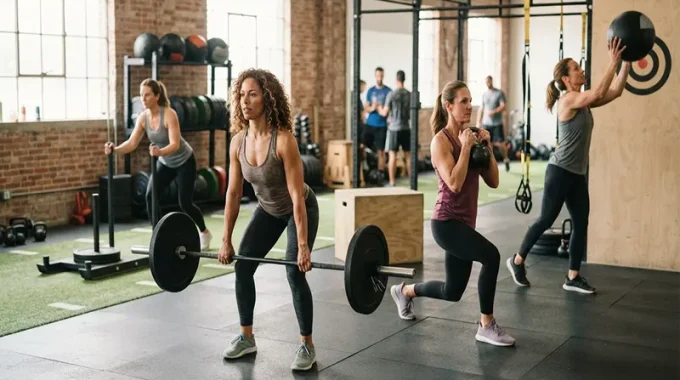
For decades, fitness culture has conditioned women to view exercise through a punishing lens: endless hours of chronic cardio, calorie-tracking, and aesthetic-obsessed routines designed to shrink the body. But as you step into your 30s and 40s, a powerful shift occurs. You realize that working out shouldn’t be a form of self-punishment; it should be an celebration of what your body can do.
Redefining fitness in these decades means moving away from calorie-burning marathons and toward building real-world strength, resilience, and physical sovereignty. Functional fitness isn’t about looking a certain way for swimsuit season. It is about building a capable, bulletproof body that supports you through every single demand of your daily life—whether you are lifting heavy luggage, playing with children, or moving through the world with unshakeable energy and confidence.
The Science of Strength in Your 30s and 40s
To understand why functional strength training is an absolute game-changer in your 30s and 40s, we have to look at the underlying physiology. Around age 30, women begin a natural, gradual decline in muscle mass and bone mineral density known as sarcopenia. If left unchecked, this can impact everything from your metabolic rate to your postural alignment and joint health.
The ultimate fountain of youth for women isn’t a magical topical cream; it is progressive resistance training. Multi-planar, compound movements send a powerful biological signal to your bones and muscles to grow stronger and denser. Strength training improves your insulin sensitivity, balances metabolic hormones, and creates a robust physical foundation that protects you against injury for decades to come.
Core Pillars of a Functional Strength Routine
A brilliant functional fitness routine mimics real-life movement patterns. It trains your body to push, pull, hinge, squat, and carry loads safely and efficiently. Here are four foundational movement patterns every woman should master:
1. Master the Hip Hinge
- Why It Matters: The posterior chain (your glutes, hamstrings, and lower back) is the powerhouse of the human body. Strengthening this area corrects the postural imbalances caused by sitting at a desk all day and protects your lower back from injury.
- How to Execute It: Incorporate conventional deadlifts, Romanian deadlifts (RDLs), kettlebell swings, and weighted glute bridges. Focus on bending at the hips while keeping a neutral spine, driving power up through your heels.
2. Push-Pull Mechanics for Upper Body Power
- Why It Matters: Real-life strength requires a balanced upper body. We constantly pull groceries, doors, and objects toward us, while pushing heavy items overhead or away from us. Balanced upper body work protects shoulder joint health.
- How to Execute It: Focus on compound movements like dumbbell rows, resistance-band pull-aparts, overhead shoulder presses, and incline push-up variations. These exercises build functional carrying capacity and upper-body autonomy.
3. Squats and Single-Leg Stability
- Why It Matters: Life rarely happens with both feet planted symmetrically on the ground. Single-leg stability and deep squat mechanics are essential for knee health, core integration, and balance as we age.
- How to Execute It: Build proficiency with goblet squats, reverse lunges, and split squats. These movements challenge your balance, fire up your core stabilizers, and build lower-body strength that directly translates to walking stairs and hiking.
4. Core Bracing and Carry Variations
- Why It Matters: True core strength isn’t about doing hundreds of crunches; it is about anti-movement—teaching your torso to remain stable and braced under a load while your limbs move.
- How to Execute It: Master farmer’s carries (walking while holding heavy dumbbells or kettlebells in each hand) and hollow-body holds or forearm planks. Farmer’s carries build grip strength, shoulder stability, and unbreakable core endurance.
Programming and Recovery for Longevity
Building a body that thrives in your 30s and 40s requires a balanced approach to programming. You don’t need to spend two hours every day in the gym; in fact, overtraining can flood your system with cortisol and hinder your progress.
Aim for 3 to 4 well-structured strength sessions per week, lasting about 45 to 60 minutes, interspersed with mobility work or gentle walking. More importantly, honor your recovery. Prioritize sleep, ensure you are eating enough protein to repair muscle tissue, and view rest days as an essential, non-negotiable part of your fitness architecture rather than a sign of laziness.
Your 30s and 40s are not a time for your body to slow down or diminish; they are a time to step into your most powerful, capable physical era.
When you shift your mindset from chasing a scale weight to building functional strength, everything changes. You stop viewing exercise as a debt you pay to look a certain way, and start viewing it as an investment in your freedom and vitality. Embrace the barbell, challenge your muscles, and step into your daily life feeling stronger, more grounded, and fiercely powerful in your own body.